
Hi everyone, I’m Puchiko! 👋
Japanese onsen (hot springs) are getting more and more famous around the world. But many first-time visitors wonder:
“Isn’t an onsen just a bath?”
“What do you actually do at a ryokan?”
The truth is, staying at a Japanese ryokan is much more than taking a dip in hot water. From slipping into a cozy yukata robe, to enjoying a beautiful kaiseki ryori dinner, to strolling through the lively onsen town—every step is part of a cultural journey.
What’s fun is that onsen isn’t just about the inn itself. The entire town becomes part of the adventure. That’s why Japanese people see an onsen trip as a special little getaway.
In this guide, I’ll share both sides of the experience:
- Part 1: How to enjoy your stay at a Japanese ryokan
- Part 2: How to explore an onsen town with all five senses
So, ready to dive into the full-course of Japanese onsen culture? Let’s go! ♨️✨
Part 1: Enjoying Your Stay at a Japanese Ryokan
1. The Experience Starts with a Yukata
1) Slip into a Yukata and Feel the Culture
When you arrive at your ryokan (traditional Japanese inn), the first thing waiting in your room is a yukata—a light cotton robe.
It’s not just pajamas. Putting it on after a soak in the hot spring instantly boosts that “I’m really on an onsen trip!” feeling.
It’s like flipping a special switch that tells you: your Japanese onsen adventure starts now.
2) Why Yukata? A Magic Key to “Un-Everyday”
Why do people at onsen wear yukata in the first place?
Traditionally, many onsen towns were seen as “one big ryokan.”
The yukata is your outfit for relaxing in that giant inn. Changing out of your everyday clothes helps you leave behind normal life and sink into the slow rhythm of the onsen town.
It feels almost like a little magical ritual ✨
3) Can I Wear Yukata Outside?
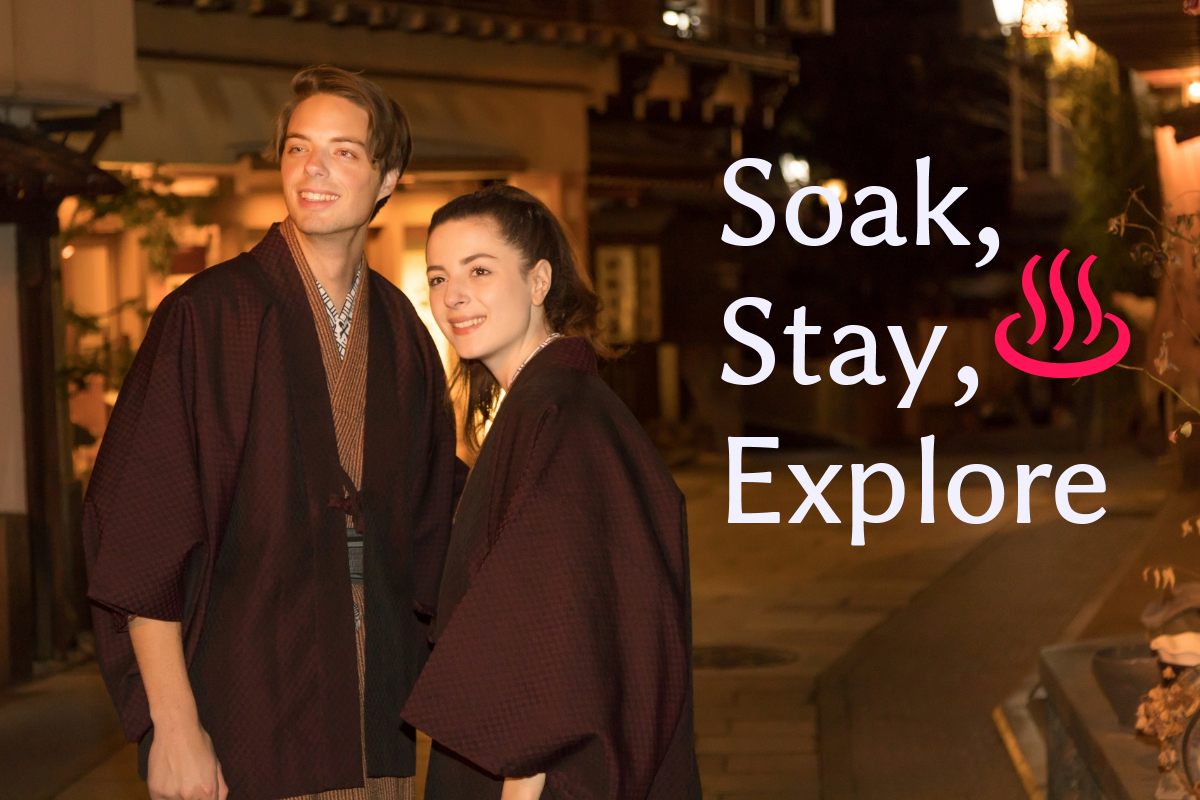
In most ryokan, yes—you can walk around both inside and outside in your yukata. Strolling the streets in your robe is part of the cultural fun.
But sometimes the yukata is for indoor use only. If you’re not sure, ask at the front desk:
👉 Useful Japanese phrase:
“Kono yukata wa soto de kite mo daijoubu desu ka?”
(Can I wear this yukata outside?)
Even if it’s “indoor only,” don’t worry. Put on a short coat like a haori or tanzen over it, and you’ll usually be good to go.
4) How to Wear a Yukata (Super Simple Guide)
Wearing a yukata looks tricky, but it’s actually really easy:
- Right under, left over. Place the right collar against your body, then fold the left collar on top. (Important! Left-over-right is for the living. Right-over-left is used only for funerals.)
- Tie the obi (belt). Wrap it twice around your waist, tie it in front, then slide the knot around to your back.
That’s it! Slip on wooden sandals (geta) and stroll through the onsen town—suddenly you’re the main character in your own Japanese hot spring story.
💡 Puchiko’s little note:
If you sleep in a yukata, somehow the belt always disappears by morning. Total onsen mystery 😂
2. After the Bath: The Culinary Story of Kaiseki Ryori
Another big highlight of staying at a ryokan is the food.
Dinner at a ryokan is often a kaiseki ryori—a traditional multi-course Japanese meal. It’s not just about filling your stomach. It’s about tasting the story of the season and the local region through each dish.
1) When to Eat
I know, after a hot soak you want to eat right away! (I feel the same 😆)
But in most ryokan, it’s common to rest a little before dinner.
Cooling down first helps you enjoy the flavors more deeply.
2) Kaiseki Is a “Small Journey”
A kaiseki dinner usually flows like a little trip, course by course:
Appetizer → sashimi → grilled or hot-pot dish → steamed dish → rice & miso soup → dessert.
Depending on the season, you might taste:
- Spring: mountain vegetables
- Summer: ayu (sweetfish) and refreshing chilled dishes
- Autumn: matsutake mushrooms and chestnuts
- Winter: crab or hearty hot pots
Each dish is carefully chosen to highlight the region and season—like a “guidebook you can eat.” 📖✨
3) Tips for First-Time Diners
- It’s polite to hold small bowls in your hand when eating.
- Pour soy sauce into the small dish and dip your sashimi, don’t pour it directly on top.
- Slurping noodles is okay in Japan—it shows they’re tasty! (No need to exaggerate, though 😅)
And don’t worry—if you’re not used to chopsticks, many ryokan will gladly bring you a fork or spoon.
💡 Puchiko’s little note:
At ryokan dinners, I always end up asking for more rice—freshly steamed Japanese rice is just too good. 🍚✨
Also, why does everyone go completely silent when eating crab? Still a mystery… 🦀
3. After the Bath: Relaxation and Play
Once you’ve soaked in the onsen and let out that “Ahhh, this is heaven!”, it’s time for the next step: resting.
In Japanese onsen culture, taking a break is part of the experience.
1) Don’t Forget to Cool Down
Stay in too long and you might experience “yu-atari” (overheating), which makes you feel dizzy or tired.
That’s why it’s important to step out, cool down, and recharge:
- Drink some water or tea
- Stretch out on a tatami mat or in the lounge
2) The Iconic Post-Bath Drink
In both ryokan and public bathhouses, there’s a quirky tradition of post-bath drinks. Popular choices include:
- Coffee milk 🥛☕
- Fruit milk 🍓🍌
- Cider or local sodas
That refreshing gulp after a hot soak? It feels like having a second bath—but inside your body! 😆
Some ryokan even offer free drinks or ice cream after your bath.
3) Fun Little Ryokan Activities
Many ryokan also offer small but memorable activities:
- Onsen ping-pong (table tennis): for some reason, everyone suddenly becomes super competitive 🎾
- Karaoke: a Japanese classic for friends and families to sing their hearts out 🎤
- Massage chairs: sit down once, and you may never get up again…
💡 Puchiko’s little note:
My unbeatable routine: lose at ping-pong → toast with coffee milk → nap on tatami.
Perfection! 😂
Part 2: Exploring the Onsen Town
Staying inside your ryokan is wonderful, but stepping out into the onsen town opens up a whole new world.
In fact, many Japanese people say an onsen town feels like “one big ryokan.”
You walk around in your yukata, eat, shop, and play—it’s all part of the experience.
Exploring the streets lets you enjoy the five senses of onsen culture.
1. The Smell of an Onsen Town
As you get closer, you’ll notice a distinct aroma—the sulfur scent of the hot springs.
Some describe it as smelling like boiled eggs, and yes, it can be surprising at first.
But for Japanese people, that moment is the sign: “Ah, I’ve arrived at the onsen.”
2. The Sounds of the Town
Listen carefully, and you’ll hear the unique rhythm of an onsen town:
- The clip-clop of wooden geta sandals on stone paths
- The soft flow of a river or the hiss of steam rising
- Cheerful voices calling out from souvenir shops
It’s like stepping into another world, far from your everyday life.
3. The Tastes of an Onsen Town
Of course, one of the best parts is street food! 🍡
- Onsen manju: warm, sweet buns filled with red bean paste
- Onsen tamago: eggs slow-cooked in hot spring water, creamy and rich
- Local sake or craft beer: the perfect way to toast your trip 🍶🍺
Somehow, everything tastes better when you’re wandering around in a yukata after a hot bath.
💡 Puchiko’s little note:
I always tell myself, “Just one or two snacks.”
But by the time I’m done, I’m completely full… oops 😅
Fun and Unique Experiences in an Onsen Town
An onsen town isn’t just about strolling—it’s a treasure chest of fun activities and retro experiences.
Step outside your ryokan and you’ll discover playful, nostalgic attractions that feel uniquely Japanese.
1) Shateki and Smart Ball 🎯
- Shateki: A classic shooting game where you aim a cork gun at prizes like candy or toys.
- Smart Ball: Japan’s old-school version of pinball, simple yet addictive for both kids and adults.
Playing these feels like a time slip back to the Showa era—and they’re perfect for fun photos too! 📸✨
2) Ashiyu: Relaxing in a Foot Bath 👣♨️
Many onsen towns have ashiyu (foot baths) along the streets or by the river.
Unlike the big baths in your ryokan, ashiyu are casual—you just need a towel.
It’s the perfect way to rest your legs while chatting with locals or fellow travelers. A small break, but a big memory.
3) Sotoyu Meguri: Hopping Between Public Baths 🛁
Some onsen towns are famous for their sotoyu meguri—a tradition of hopping between multiple public baths.
Each bath has its own personality:
- One may have a strong sulfur scent
- Another leaves your skin silky smooth
- Another might be a hidden gem only locals know
Trying different baths in one trip is a luxury only an onsen town can offer.
💡 Puchiko’s little note:
I always get carried away with bath-hopping… and end up dizzy.
But that post-bath soda afterwards? Absolutely worth it! 🥤✨
Conclusion: The Best Onsen Experience Comes from Both Ryokan and Town
A stay at a Japanese ryokan is already special—slipping into a yukata, soaking in the hot spring, savoring kaiseki ryori, and resting on tatami mats.
But step outside into the onsen town, and the experience grows even richer. A foot bath by the street, snacking on warm onsen manju, or trying retro games like shateki—these little moments add up to the full course of Japanese hot spring culture.
Remember, onsen etiquette isn’t about strict rules. It’s simply about consideration for others so everyone can relax together.
With just a little courage to step into this world, you’ll discover an experience that stays with you long after your trip ends.
So why not make your Japanese onsen debut? The doors are open, and unforgettable memories are waiting. ♨️✨
Check out this article too — it’ll make your hot spring time even better! ♨️😄